
'It would not be incorrect to say that the Chinese-Pakistani strategy of containing India began in the aftermath of the 1965 war.'

'The Indian side has realised that not talking to Pakistan has not served any useful purpose.'

Former prime minister Jawaharlal Nehru had sought American assistance and wrote to the then US president John F Kennedy to provide India jet fighters to stem the Chinese tide of aggression during the 1962 Sino-India war, according to a new book.

'Notwithstanding the realisation among the Indian leadership to build up its navy for the force's expanding role, the Indian Navy was allocated only 15% of the interim defence budget presented in Parliament in February 2019.' 'The outlay for the navy's capital acquisition is not even adequate to meet its committed liabilities,' points out Brigadier S K Chatterji (retd).
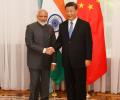
'The fact that Modi and Xi exuded confidence to accelerate the negotiations for a border settlement alone underscores that the Russia-India-China triangle has become very dynamic,' notes Ambassador M K Bhadrakumar.
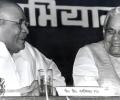
'Like General Patton, possibly the greatest exponent of the art of war, Vajpayee had the ability to be always on the offensive,' assesses Colonel Anil A Athale (retd).

'It was India's good fortune to have a Vajpayee lead the government at this crucial moment in history.' 'By taking the N-decision he saved future generations of Indians from being 'Kosovoed' or 'Iraqed',' says Colonel Anil A Athale (retd).

The question really is whether the US can be persuaded to embark on a path of calibrated and stronger sanctions on Pakistan.

The year is coming to an end and overall, it's been one hell of a year! We have had our share of ups and downs and we look forward to a better 2020. While we count down the days to the new year, let's also reflect on those who gave us strength to stand up in what we believe, the courageous who didn't bow down and the ones with gumption who inspired us to be better. We, Rediff.com, have selected 26 personalities, who we think are worthy of the title -- HERO OF THE YEAR -- and we want you, dear readers, to choose your hero!

While the DMK fears that the Congress with its poor strike rate will pull it down in the 2021 state elections, like it did five years ago, the ruling AIADMK is worried that the BJP may ultimately do a Bihar on it, relegating it to second place in Tamil Nadu, says N Sathiya Moorthy.

'In 2019, in Modi we have a leader who has not shied away from showcasing a robust and aggressive response to the Pulwama and Uri attacks,' says Colonel Anil A Athale (retd).

United States President Barack Obama will have a tight schedule during his three-day visit starting January 25, as he will hold talks with top leadership in New Delhi on ways to make progress on key issues like defence and civil nuclear agreement and attend the Republic Day celebrations as the chief guest, among other engagements.

'You shouldn't mistreat Muslims, you shouldn't mistreat Sikhs, you shouldn't mistreat anyone you perceive to be the other.'

The Bharatiya Janata Party has cautioned the United States against any peace talks with the Taliban arguing the terrorist outfit is unlikely to change its behaviour and as reconciliation effort would be a futile exercise.

'... For the India-US relationship to continue its positive trajectory, it will require India to adapt to a different approach.' Nisha Desai Biswal -- who as the Obama administration's point person for South Asia was in the inner circle of all the Obama-Modi Summits -- tells Rediff.com's Monali Sarkar why she is hopeful that India and the US are on an irreversible forward course.

We present our alphabet of 2020, pulling in everything you'll remember about this year we'd rather forget.

During Vajpayee's tenure, he was there as an indispensable insider, witness to every action that had an impact on history: Pokhran-II (nuclear tests in 1998), the 1999 Kargil conflict between India and Pakistan, the Indo-Pak Agra Summit in 2001, intense engagement with the United States on nuclear issues besides the Kandahar hijack.

Arpi deserves to be complimented for the commitment and hard work that have gone into this production. The frustrations of seeking reliable documentation from the catacombs of the Indian bureaucracy did not deter him from going after the best information available, and the result is one that he can take much satisfaction in. Ambassador Prabhat P Shukla, Member Advisory Council, Vivekananda International Foundation, reviews Claude Arpi's The End of an Era: India Exits Tibet.
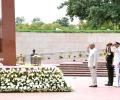
'Since each chief single-mindedly pursues his service's interests in the competition for turf and in core matters such as budget share. The CDS, therefore, must act as an "honest broker" whose decisions serve the broader national purpose, rather than narrow service interests,' says Ajai Shukla.

'We are encouraged by what the prime minister said recently on these issues... We will keep a close eye on these issues. They are very important and as are other elements of our human rights and religious freedom.' 'So, absolutely, we'll keep a focus on them.'

'Everybody says 5G and communication is important.' 'Everybody says automation, robotics, human computing interfaces -- people and machines working together -- is the future.' 'Everybody agrees that cybersecurity is something that is here to stay.' 'Everybody agrees that synthetic biology is important.' 'Instead of outlining thinking about industries for tomorrow and the future, let the evolutionary pathway be built in a way that it promotes robust, creative, thinking.'

'As a society, we are very intolerant to failures which is contrary to entrepreneurship because all entrepreneurs will not succeed.'

'An operation such as the Mumbai attacks, which needed expert technical assessment, money and time to prepare, could not have been carried out without the knowledge of the ISI's leadership.'

Vajpayee had always felt that India must act with conviction and panache. He decided that, irrespective of the attendant risks, he would undertake what many felt was a precarious course. A fascinating excerpt from N K Singh's Portraits Of Power: Half A Century Of Being At Ringside on Atalji's 96th birthday, December 25.
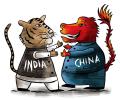
'China's vulnerability on the global stage has given an opening to India to push for its own interests,' notes Harsh V Pant.

Although the first woman to hold the position of chief economist at IMF, it would be wrong to see her appointment through the lens of gender
While it took the Congress nearly a half century to earn the hatred of other political outfits, the BJP appears set to reach there in around six years, says Arun Bhatnagar, former secretary to the GoI.

A friendly working environment, special healthcare facilities, flexible work hours, work from home options, support and camaraderie among the team members keep employees highly motivated in these 10 companies.

'I feel now we have a leader who is non-corruptible.' 'But he needs time as corruption is deep-rooted in our society, and people have no shame about being corrupt.' 'It will take at least 7 years to make some changes.'
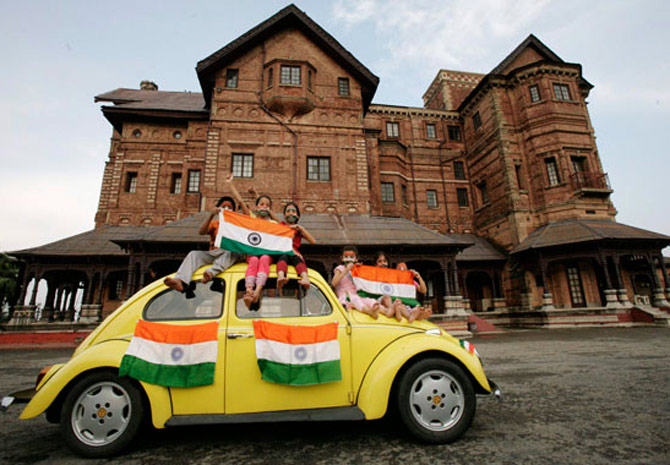
Through the book 'Make in India' authors Ranjini Manian and Joanne Grady Husky bring you the wisdom of twelve CEOS who walked the trail before them.
Pakistan's ruler Pervez Musharraf and his top diplomats made a U-turn on talks with India after the then Prime Minister Atal Bihari Vajpayee released Hurriyat leaders in early 2000 as part of his peace initiatives on Kashmir, according to a declassified US cable.

Consumers are set to gain from discounts.
Wisner said during a discussion organised by Asia Society here yesterday on the Indian elections.

'In the time I have been an Indiawallah, I have seen three US Presidential visits to India, nuclear sanctions, nuclear cooperation, a border conflict with Pakistan, the growth of IT services, a government losing a confidence vote, and so much more,' Rick Rossow, the new Wadhwani Chair in US-India Policy Studies tells Rediff.com's Aziz Haniffa.

The Diaspora is no longer a mere remittance economy. It today claims dual loyalty and demands a say in Indian politics, says sociologist Shiv Visvanathan
'A hundred days later, it is a moot point whether the lockdown has been partially or totally effective, or, as sceptics indicate, plain ineffective.' 'Did it actually deflect infections and the loss of lives, or was it merely a hasty decision rammed down the populace's throats that choked the economy and caused the searing tragedy of dispossessed migrant workers?' ask Radha Roy Biswas and Manoj Mohanka.

'India was in no position to wage another war in 1965, having suffered a morale-shattering defeat in 1962. The three services were in the middle of a modernisation and expansion phase and therefore not fully trained or battle-ready.'
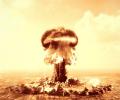
The new government must initiate a comprehensive review of India's nuclear weapons doctrine and posture. Ajai Shukla explains

'We use the word "historic" perhaps too much, but the prime minister's visit certainly was historic in so many ways.'

'Modi's promise of change during the election campaign was on the domestic front, but his first year in office focused on foreign policy beyond all expectations,' says Ambassador T P Sreenivasan.
